
For most people, blame feels like a judgment.
For doctors, blame feels like a biography.
It is remarkable — and quietly devastating — how quickly the world reorients itself when a medical outcome turns unexpected. The scalpel, the pen, the signature, the call — everything becomes a timestamp. And the doctor becomes the system.
I remember sitting with a senior surgeon once, a man with more calm in his hands than most of us have in our entire bodies. A complication had occurred. Medically explainable. Statistically expected. Legally defensible.
And yet, he sat with the silence of someone who had wronged an entire village.
“Where did I fail?” he asked.
Not: Where did the process fail?
Not: Where did the infrastructure fail?
Not: Where did the system collapse under its own familiar weight?
Just: Where did I fail?
That one line is the entire psychology of blame in Indian healthcare.
The system delegates responsibilities upward.
The public directs emotions inward.
The doctor absorbs everything silently.
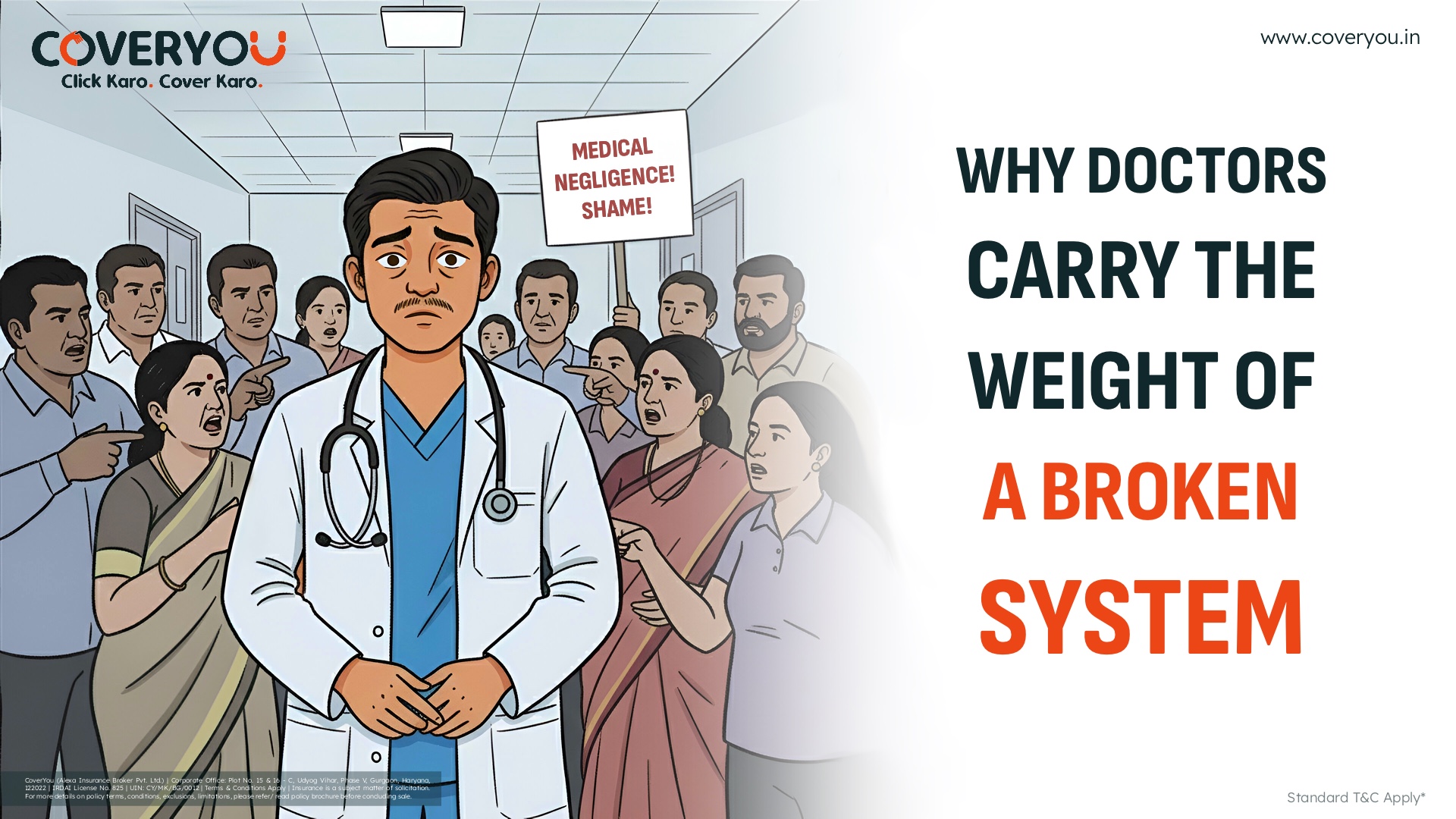
There is a theory in behavioural science that the human mind, when confronted with fear, prefers a single identifiable target. It makes chaos digestible.
Hospitals are complex ecosystems. Law is a web. Protocols are layers. But a doctor — a human, visible, reachable — is simpler for the mind to hold accountable.
So blame travels to the first stable object it can find.
And doctors, ironically, are the most stable.
But guilt in medicine is not linear. It doesn’t move from event → reflection → resolution.
It moves like a spiral — clinical facts at the surface, emotional residue at the centre.
Most doctors are never taught how to separate the two.
Medical colleges teach anatomy, not self-blame patterns.
Residencies teach endurance, not emotional compartmentalisation.
Practice teaches responsibility, not boundaries.
So blame becomes internal architecture.
Even in cases where the doctor is not wrong, not negligent, not even remotely responsible — the self-questioning begins before the paperwork does.
Did I miss something?
Did I rush?
Could I have explained better?
Should I have seen earlier what no one could have predicted?
This is the part nobody sees.
The cognitive load.
The mental editing.
The silent replay of moments.
And layered beneath all of it — a truth the system rarely acknowledges:
Doctors carry more guilt because the profession demands more humanity than the world is willing to give back.
Perhaps the question is not “Why do doctors get blamed?”
That has answers — legal, systemic, cultural.
The real question is:
Why do doctors accept the blame even before it arrives?
Until that is addressed — with support, with clarity, with better systems — the burden will continue to sit on the wrong shoulders.
And the world will continue to lean on the one profession that keeps showing up, even after being shown the door of accountability one too many times.