
A few years ago, long before CoverYou became a structured organisation, I witnessed a moment that changed the way I look at insurance, claims, and the emotional life of a doctor.
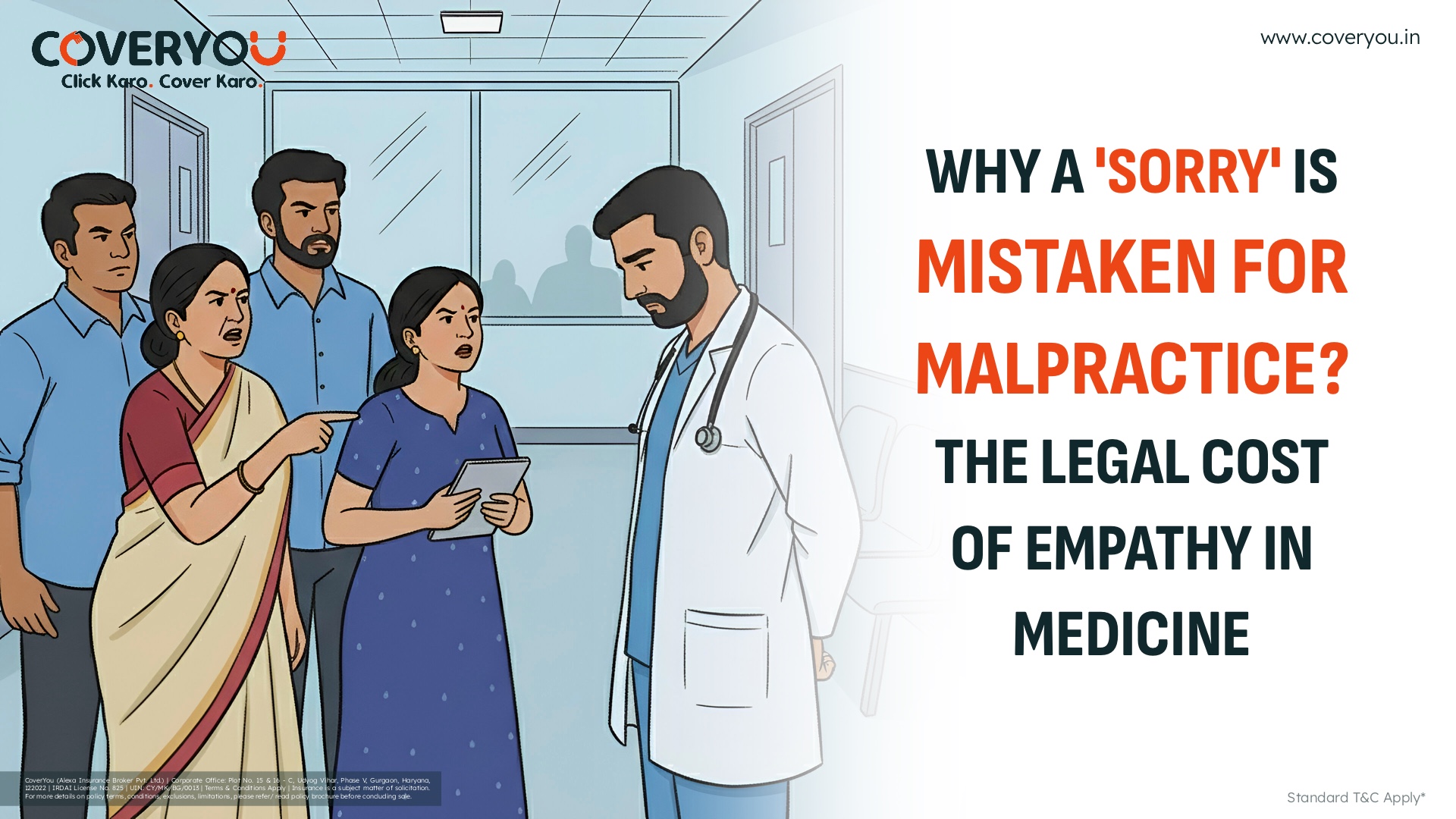
A patient’s family had escalated a matter – angry, grieving, convinced that the outcome could have been different. The doctor in question had done everything right. Every note was clear. Every step defensible. Every decision medically sound.
And yet, in the middle of that charged room, he said the words no one expected:
“I’m sorry.”
Not for an error.
Not for a lapse.
But for the shock the family experienced – shock he did not create.
I realised then that apologies in medicine are not statements of guilt. They are statements of humanity.
But humanity is the one thing the legal system is not built to interpret.
The family took the apology as confirmation.
The crowd took it as confession.
The narrative took it as negligence.
And the doctor – who had acted with precision, calm, and competence – suddenly looked like the centre of a storm he never created.
That moment taught me more about liability than any document ever could.
Because this is the truth almost nobody spells out:
In healthcare, perception travels faster than facts.
A doctor’s apology – even when rooted in empathy – can be mistaken for culpability.
A doctor’s silence can be mistaken for defensiveness.
A doctor’s calm can be mistaken for detachment.
A doctor’s confidence can be mistaken for arrogance.
The medical world is wired to be rational.
The legal world is wired to be adversarial.
The emotional world is wired to be reactive.
And doctors stand at the intersection of all three.
The same surgeon later told me, “If I don’t acknowledge what they’re going through, who will? But if I do, people think I’m admitting fault.”
That is the paradox that doctors endure daily.
And it reveals something fundamental:
The practice of medicine is not just clinical – it is relational.
And relationships are the most unpredictable liability.
We work with hundreds of cases.
We study patterns.
We analyse behaviour.
We read every line in every claim.
And yet, the most fragile moment in a doctor’s life is still the one where their compassion intersects with someone else’s pain.
Because facts can be defended.
Complications can be explained.
Protocols can be shown.
But emotions rarely follow documentation.
The doctor who apologised that day taught me that the biggest vulnerability in healthcare isn’t always medical error.
Sometimes, it’s decency.
And until systems evolve to separate empathy from admission, and conversation from culpability, doctors will continue to stand alone in rooms that should have been shared by many.