
Cheap policies feel sensible.
They meet requirements.
They reduce upfront cost.
They appear equivalent at a glance.
For years, they work perfectly — because nothing tests them.
The problem begins only when a claim enters the system.
At that point, cost reveals itself differently.
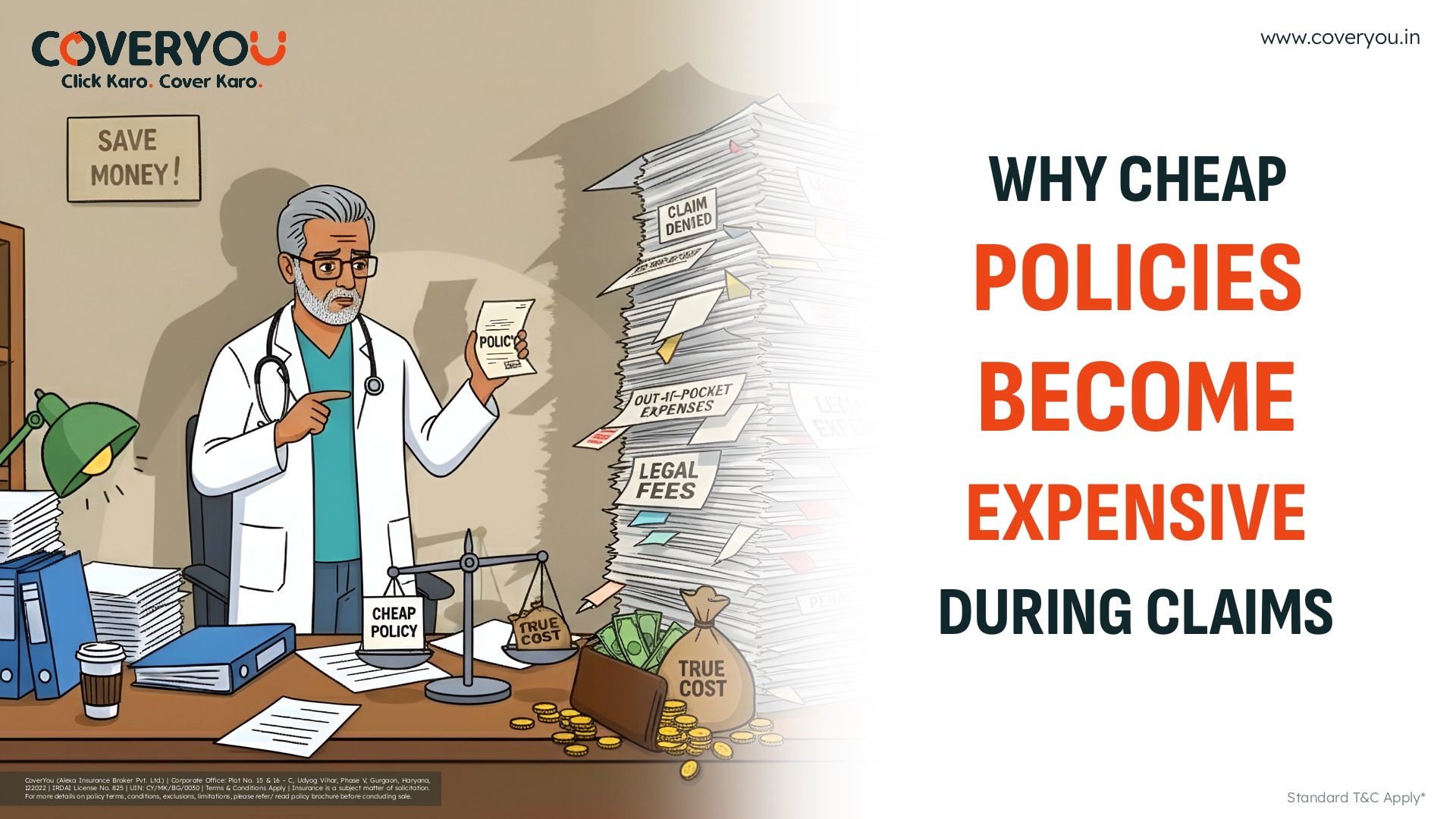
Cheap policies are not incomplete. They are selective. They provide coverage, but with tighter conditions — narrower definitions, stricter limits, and more exclusions that remain invisible until activated.
Doctors often discover this during claim assessment.
Coverage exists, but not in the way they expected.
Support is provided, but not at the scale they assumed.
The expense does not appear as rejection.
It appears as reduction.
Partial payouts.
Out-of-pocket expenses.
Delays caused by clarification loops.
What was saved earlier is paid later — not financially alone, but emotionally and administratively.
This doesn’t mean higher premiums guarantee better outcomes. It means that cheaper policies demand higher tolerance for procedural friction.
Most doctors are not told this explicitly.
Policies are compared on price, not behaviour. On coverage names, not on how they respond under pressure.
Cheap policies work well when nothing is required of them. But claims require responsiveness, interpretation, and flexibility — areas where cost-cutting often shows.
The expense, then, is not the premium difference.
It’s the mismatch between expectation and execution.
Experienced practitioners learn this over time. They stop asking whether a policy exists and start asking how it behaves when challenged.
Because the real cost of insurance is not what you pay annually.
It’s what remains uncovered when it matters.
End.