
For decades, the doctor–patient relationship functioned without external oversight.
Disagreements were resolved through conversation. Dissatisfaction travelled through word of mouth. Accountability existed, but it was informal — mediated by professional ethics, peer opinion, and community trust.
This did not make medicine careless.
It made it personal.
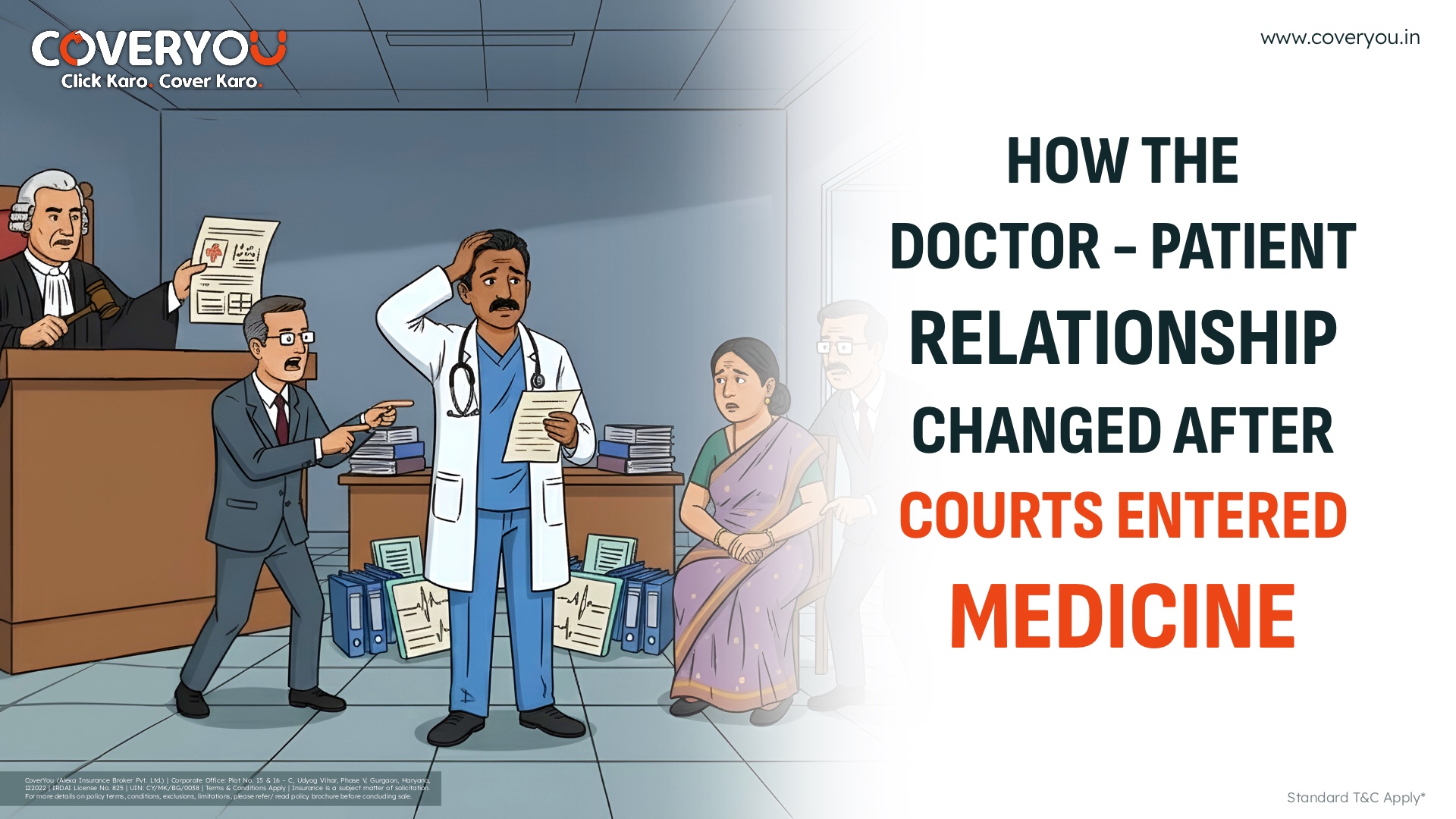
When courts began to engage with medical practice, the shift was not sudden, but it was decisive.
Initially, legal intervention was rare. Cases surfaced only in extreme situations — clear negligence, obvious harm, undeniable misconduct. Doctors viewed them as exceptions, not precedents.
But exceptions have a way of becoming reference points.
As medical care grew more complex, outcomes became less predictable. Expectations rose alongside access to information. Patients began to see treatment not only as care but as a service — something that could be evaluated, questioned, and contested.
The relationship changed quietly.
Earlier, trust was assumed unless broken.
Now, trust increasingly needed documentation.
Consent moved from conversation to paper. Explanations became more formal. Case sheets expanded — not necessarily to improve care, but to preserve clarity.
Doctors began practicing in two parallel spaces:
- the clinical space, guided by judgement and experience
- the legal space, shaped by interpretation and precedent
Neither was wrong.
But they were not the same.
This duality altered how conversations unfolded. Language became cautious. Certainty was expressed carefully. Silence, once neutral, began to carry risk.
Patients, too, adapted.
Questions changed in nature. Follow-ups became structured. Dissatisfaction found formal channels rather than informal resolution. The relationship grew more explicit, less intuitive.
What was lost was not compassion — but assumption.
Doctors could no longer assume understanding.
Patients could no longer assume infallibility.
Courts did not weaken the doctor–patient relationship. They formalised it.
What had once relied on mutual faith now relied on mutual clarity.
The challenge for modern medicine is not to return to the past but to recognise what changed — and why.
Trust still matters.
But it now shares space with accountability.
And the relationship, once personal by default, must now be consciously maintained.
End.